The cross at Tomar is the Order of Christ’s, not the Templars’ — and the Templar cross is less documented than often assumed
Start with what the Rule actually says
The Templar Rule was written in 1128 and entered at the Council of Troyes in 1129. Its clause 17 grants the brothers the white mantle. That is the documented habit of the order, and the Rule says nothing whatever about a cross.
The white mantle is therefore the part of the famous image that rests on a primary document. Everything red about it comes later, and comes from somewhere less firm.
The red cross: a traditional date and a missing document
The grant of the red cross is traditionally assigned to a chapter held at Paris on 27 April 1147, under Pope Eugene III. Not lost and argued over — simply not produced. Much writing about Templar heraldry rests on that date.
And the shape rests on even less. No document prescribes what the cross looked like. The identification of it as a cross pattée comes from pictures: the order’s seals, and the San Bevignate fresco at Perugia, which is late 13th century. So the colour is documented and the form is an inference drawn from surviving images (the same problem, with a window).
| The claim | Status | What it actually rests on |
|---|---|---|
| The Templars wore a white mantle | Documented | Clause 17 of the Rule, 1129 |
| The mantle carried a red cross | Traditional | A chapter of 27 April 1147; primary source not produced |
| The cross was a cross pattée | Inferred | Seals and the San Bevignate fresco, not a rule |
| Two knights on one horse meant poverty | Not documentary | The Rule allowed three horses and forbade the practice |
| Non nobis Domine was the Templar motto | Unsourced | Psalm 113:9; its documented history runs elsewhere |
| The cross at Tomar is Templar | Wrong | It is the Order of Christ’s, and it looks different |
Six claims, one of which is supported by a primary document.
The seal, and the best fact on this page
The Grand Master’s seal shows two knights riding one horse. The seal is in use from 1158, under Bertrand de Blanquefort, and the two-knight face is documented from 1167. Guidebooks often say it symbolises the order’s original poverty: two men so poor they shared a mount.
Now read the Rule. It allowed three horses per knight, and it forbade two brothers to ride one. The order’s own regulations prohibit exactly the thing its Grand Master’s seal depicts.
That does not make the seal meaningless — an emblem can be a statement of an ideal rather than a photograph of practice, and it may well have been read that way at the time. What it does mean is that the poverty explanation is a reading, not a documented one, and that the Rule, cited in the same encyclopaedia article, sits awkwardly with it.
The Beauceant, and what the word means
The Templar banner is called the Beauceant, and the word is Old French for a piebald horse — a black-and-white one. The popular gloss deriving it from bien-séant, “becoming” or “seemly”, is a later interpretation rather than the meaning. Sources even disagree about which half was black. The red cross on the banner appears to be a later 13th-century addition.
There is one named contemporary who explains it. Jacques de Vitry, writing in the 1220s, glosses the two colours as ferocity to their enemies and kindness to their friends. That is a medieval writer telling you what a medieval symbol meant.
The Latin motto, and what it actually says
People arrive here wanting Non nobis Domine, non nobis, sed nomini tuo da gloriam — not to us, Lord, not to us, but to your name give the glory — confirmed as the Templar motto. The evidence points elsewhere, and the reason is an interesting one.
- It is scripture. The line is Psalm 113:9 in Vulgate numbering. It was not composed for anybody in the twelfth century.
- Its documented history runs somewhere else entirely. Through Agincourt — the account of it sung there comes from Hall’s Chronicle, printed in 1542, well over a century after the battle of 1415 — through English Protestant devotion after 1605, and through Freemasonry. Not through the Temple (that connection, examined).
- Even the encyclopaedia hedges. The sentence attributing the phrase to the Beauceant carries the editorial flags [by whom?] and [year needed].
So the answer is: it is a psalm, it is genuinely associated with the Templars in popular culture, and no source establishes that the order used it as a motto.
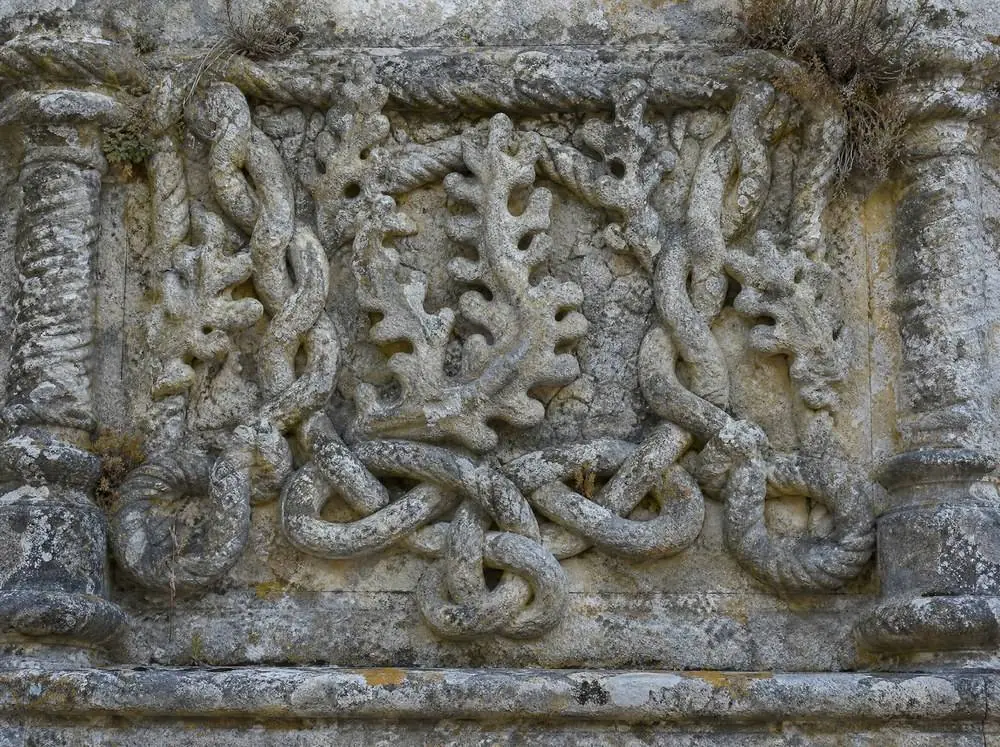
And now the cross you will actually be looking at
Here is the distinction the whole page turns on. The cross at Tomar is the Order of Christ’s. The Templars held this castle for a century and a half; then the order was dissolved, and almost everything carved, painted and blazoned here — the Manueline church, the cloisters, the window — was made by the Order of Christ after 1319 (who they were).
And the two crosses do not look the same. The Order of Christ’s is a red cross carrying a white inner cross — that inner cross is the element the Templar cross does not have, and once you have seen it you cannot unsee it. On the arms themselves: the Temple’s curve, while the Order of Christ’s are straight with serifs, a distinction drawn by Rui da Costa Pinto. The modification is dated to about 1400, though no firm first attestation exists.
This site’s own logo takes the same care. The mark in the header is a squared cross on a plate: the Order of Christ reduced to what a small square can hold, in a simplified form.
The cross on the sails — and why the claim has to be split in two
The Cross of Christ on the sails of Portuguese ships is one of the most reproduced images in European history, and it is two different claims with two different evidential standings.
| Which ships | Evidence | The catch |
|---|---|---|
| 16th-century naus | Iconographic support | The Livro de Lisuarte de Abreu is c. 1563 – about sixty years after the voyages it depicts |
| Henry the Navigator’s 15th-century caravels | None found | No contemporary document and no contemporary image |
No royal order prescribing the cross on sails has been produced either.
What is solid is how the badge became a country’s. Manuel, duke of Beja, was governor of the Order of Christ, and when he became King of Portugal the Cross of Christ “came to be regarded and used as a national emblem of Portugal”. The emblem of a military order attached itself to the state because the head of the order became the head of the state — which is also why the church here fills with Manueline carving in the same reign (the window).
If the symbolism is the reason you are coming, book somebody who can point at it. K, on a private tour here, describes a guide who “had a book with him where he showed us diagrams of the site building and symbology” and adds: “I couldn’t imagine touring the site without a guide, there’s so much more than face value.” That listing is 4.7 on 109 ratings and is priced per party rather than per person. Adriana M, on the same listing, calls the convent “um lugar de muita história e cheio de símbolos” — a place of much history and full of symbols.
The one symbolic reading the dates rule out entirely
Any Masonic interpretation of the carving here. The Charola was begun in 1160 and the Order of Christ was recognised in 1319; the first Grand Lodge dates from 1717. Reading Masonic symbolism into this building means projecting an eighteenth-century system backwards onto twelfth- and sixteenth-century Christian and maritime imagery, and the dates alone dispose of it (the full account, with the sources).
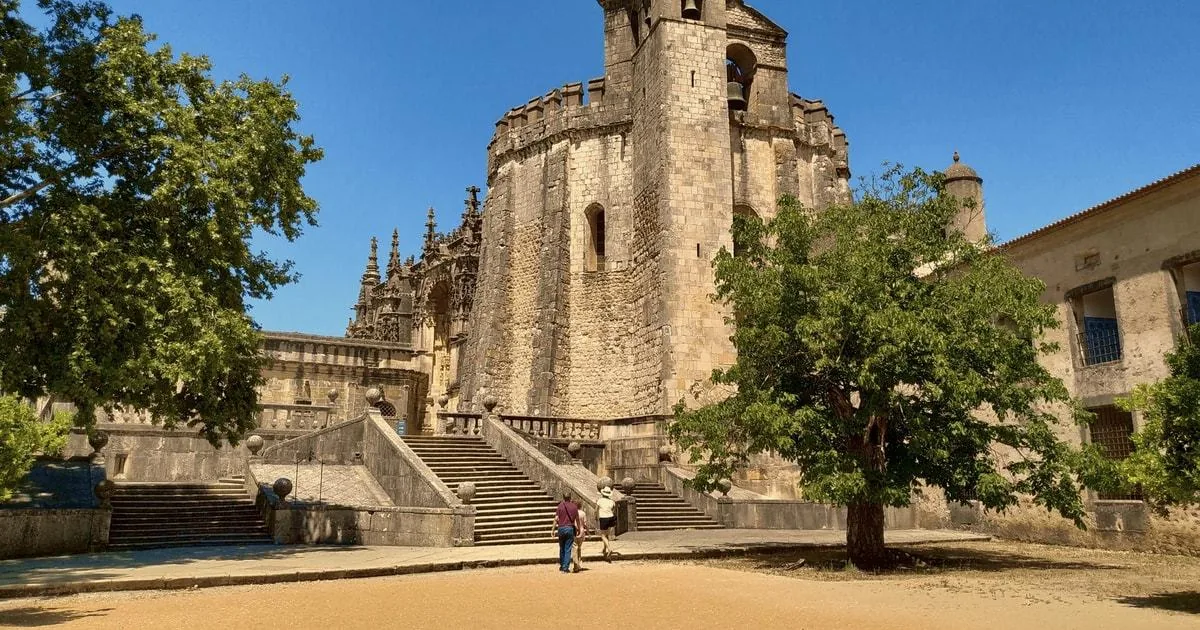 Priced per party
Tomar: Knight's Templar Castle and Convent of Christ Tour
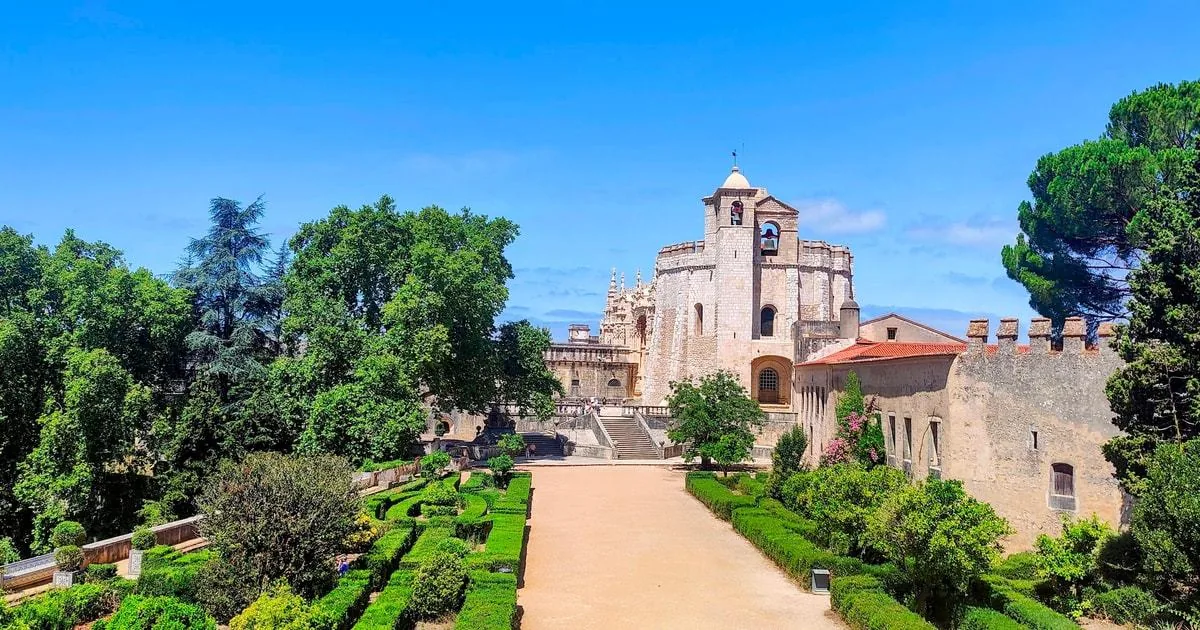 Convent and synagogue
Walking Tomar: Templar Secrets & Convent of Christ Included
 The whole day, in Tomar
Tomar and the Templars Convent of Christ: A Historical Tale
Next: the order whose cross this is, the order that built the castle, and the carving everybody photographs.
Frequently asked questions
What is the cross at the Convento de Cristo?
The Cross of the Order of Christ: a red cross carrying a white inner cross. That inner cross is the element the Templar cross does not have. Nearly everything carved and painted at Tomar was made by the Order of Christ after 1319, not by the Templars.
What was the symbol of the Knights Templar?
A red cross on a white mantle — but only the mantle is in the Rule of 1129, which says nothing about a cross. The red cross is traditionally dated to a chapter of 27 April 1147 and the primary source for that grant has not been produced. The shape is inferred from seals and one fresco.
Is the Templar cross a cross pattée?
That is an inference, not a rule. No document prescribes the form of the Templars’ cross; the pattée identification rests on the order’s seals and the late 13th-century San Bevignate fresco at Perugia. Colour is documented; shape is reconstructed from pictures.
What is the Templar motto in Latin?
Non nobis Domine is what people mean, and it is Psalm 113:9 in Vulgate numbering rather than anything composed for the order. Its documented history runs through Agincourt, English Protestant devotion and Freemasonry; the sentence attributing it to the Templars is flagged as unattributed and undated.
Why do the Templar seals show two knights on one horse?
Nobody can document why. The usual answer is poverty, but the Rule allowed three horses per knight and forbade two brothers riding one — so the seal, in use from 1158 with the two-knight face documented from 1167, depicts something the order’s own regulations prohibited.
What does Beauceant mean?
Old French for a piebald horse, a black-and-white one. The derivation from bien-séant is a later gloss. Sources disagree about which half of the banner was black, and Jacques de Vitry, writing in the 1220s, explained the two colours as ferocity to enemies and kindness to friends.
Did Portuguese ships really fly the Cross of Christ?
Split the question. For 16th-century naus there is iconographic support, though the manuscript usually cited is from about 1563, some sixty years after the voyages it shows. For Henry the Navigator’s 15th-century caravels no contemporary document or image has been found.